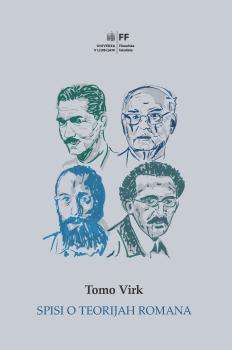
Spisi o teorijah romana
Keywords:
novel, literary theory, literary genre studies, Slovene novelSynopsis
Tomo Virk’s book O teorijah romana (On the Theories of the Novel) minutely examines four great and most resonant theories of the novel: two international and two national ones. It starts with a discussion of György Lukács’s theory, which exercised exceptional influence throughout the 20th century despite its severe limitations of the concept of the novel and hastiness in predicting the end of the genre. These problematic traits of the Hungarian theorist are interpreted by Virk in light of his overall course of thought. This course is characterised by an outwardly deeper break at the end of the Great War, but also by a continuity which helps explain the peculiarities of Lukács’s novel theory. The other international theory of equal significance and impact is Mikhail Bakhtin’s. Much broader than Lukács’s, it is different in other respects as well, drawing on the ideas of the Jena Romanticism rather than on the Huet-based tradition of reflections on the novel, and relying on cultural studies rather than on a philosophy oriented towards the Geistesgeschichte, history of ideas. Virk seeks to show and trace the ‘essence’ of Bakhtin’s definition of the novel, again pointing out the open issues.
Still closer examination is afforded to the two Slovenian theories of the novel, authored by Dušan Pirjevec and Janko Kos. Both Slovenian theorists develop not only a general theory of the novel but also a separate theory of the Slovenian novel, though the latter remains a draft in the case of Pirjevec. While Pirjevec and Kos agree in identifying the specifics of the Slovenian novel, their theories still diverge in significant ways. In its philosophy, Pirjevec’s theory is based on Heidegger, while its literary criticism relies on Lukács’s theory of the novel but turns out to be even more reductive. Much more scientific is Kos’s theory of the novel, the broadest and most realistic of the four because it takes into account the observation about the openness of the genre and does not seek to cram the novel’s ‘essence’ in a too-narrow frame, as do the other three.
Downloads
Downloads
Published
License

This work is licensed under a Creative Commons Attribution-ShareAlike 4.0 International License.